
What is sterilization?
Sterilization is the process of completely eliminating all microorganisms, including the most resistant bacteria and spores.
Why sterilization is difficult to verify
Achieving true sterilization is both challenging and difficult to verify. Although many chemical agents, both organic and inorganic, can kill microorganisms, they are not always completely effective and may leave unwanted or toxic residues behind.
The limits of radiation methods
Ultraviolet and ionising radiation are also effective biocides, as they disrupt or alter DNA to prevent microbial replication. However, ultraviolet radiation does not achieve the same level of effectiveness or validation ease as moist heat sterilization. When absolute sterility is required, scientists today, just as in the past, rely on steam.
How steam destroys microorganisms
Microorganisms generally become more active as their surrounding temperature increases, most, though not all, are destroyed at temperatures above 80°C. Prions, however, require significantly higher temperatures and longer exposure times for deactivation. During steam sterilization, steam molecules condense on the cooler surfaces of microorganisms, releasing about 2,500 joules per gram of steam.
This process efficiently transfers heat, raising microorganisms to the temperature at which they are destroyed. Other heating methods, such as dry hot air, are far less effective due to lower heat transfer and boundary layer effects that can insulate and protect microorganisms.
For maximum effectiveness, the steam must be saturated. This condition, along with the steam’s temperature and pressure, can be easily monitored, providing clear proof that sterilization has been achieved. By using steam sterilization techniques, a high level of sterility can be ensured, which is why the steam sterilizer, or autoclave, remains the most widely used equipment in laboratories and hospitals.
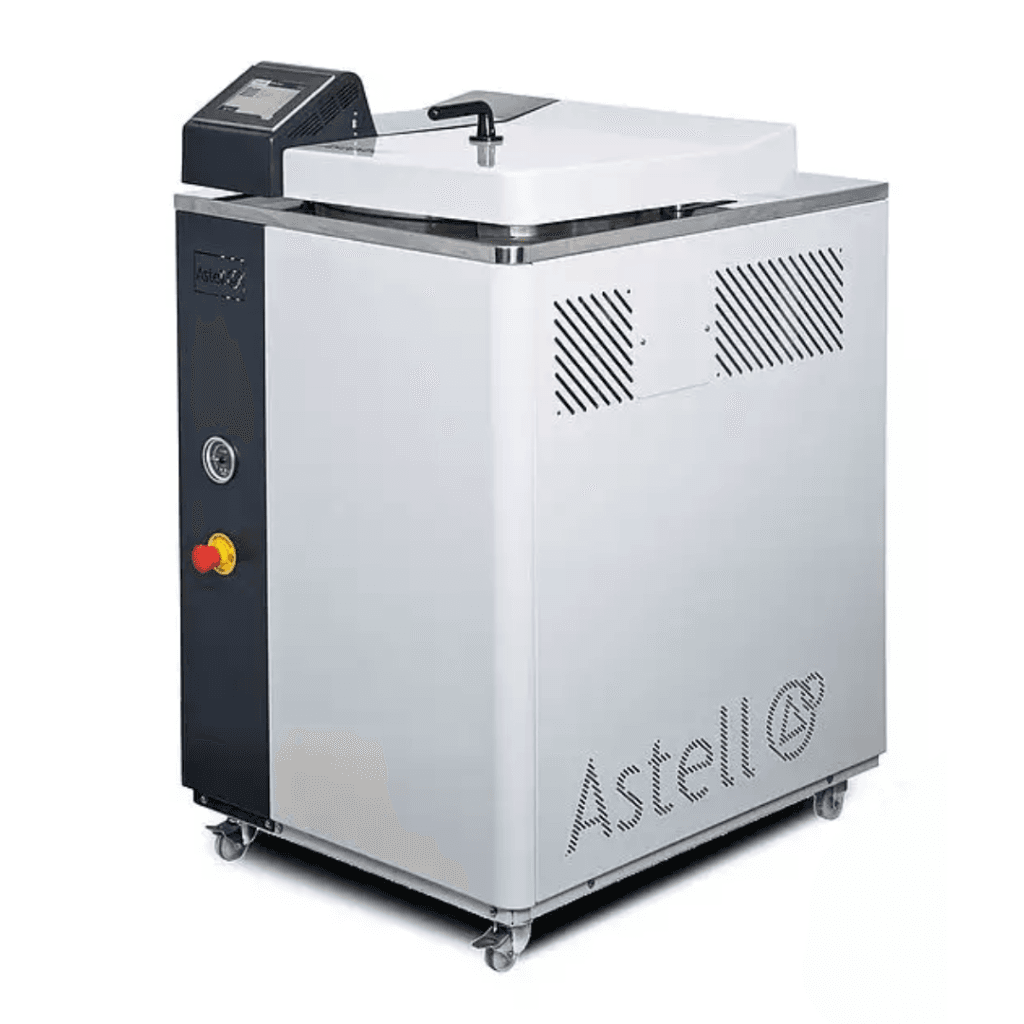


Top-loading autoclave
The top-loading autoclave range offers larger chamber sizes. There are three available sizes: 95, 120, and 135 liters.
Autoclave with drying
Duaclave
The perfect autoclave range for laboratories with limited space, featuring two identical chambers.